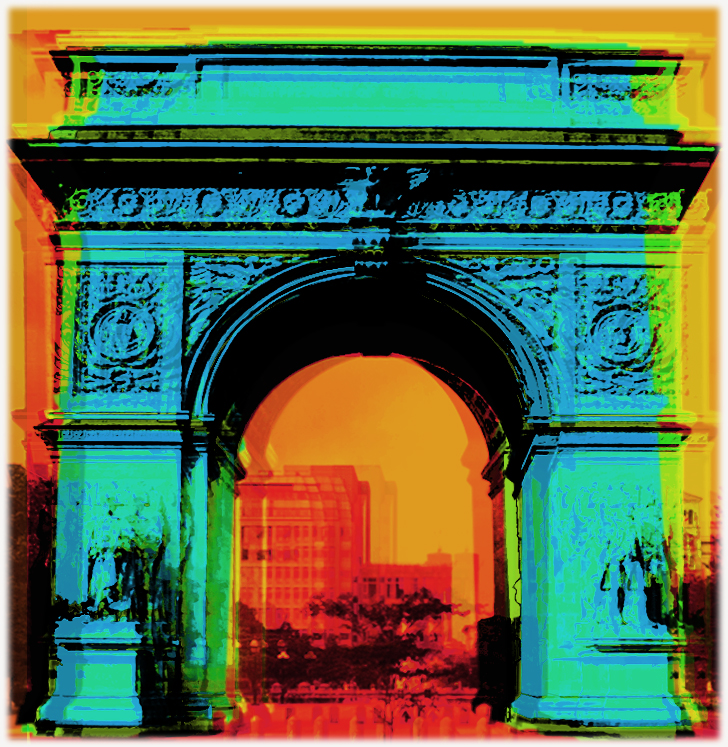
My new e-book is now available on smashwords as a FREE download. It contains three of my short stories:
"The Plumbline" chronicles the effects of a heat wave and an accidentally awakened Kundalini. As the temperature rises, an exhausted physics and geometry lose their hold on the city, and a chance combination of spoken words awakens a range of visions which include the vengeful ghost of S. Klein-on-the-Square roaming through a spectral Union Square Park, and the combined prayers of every soul in the square become audible and raise themselves into a great petition, as the narrator tries desperately to hold on to this rare and beatific vision as it begins to slip away from him.
"The Floods" describes a strange and unnatural tide that has risen up overnight to the very ledge of the narrator's bedroom window and seduces him out into a cove of preternatural stillness and great beauty, as he finds himself exploring the landscapes of his childhood—but seen through a lense of regret and missed opportunities.
"The Reprieve" is the story of a merciful act: a rare and beautiful creature's life is spared by the narrator, who then reveals his inner thoughts and his seemingly altruistic act is shown to be the result of mere chance and arbitrariness, as he explores his own motivations, weaknesses and character failings.
Monday, October 7, 2013
Friday, September 6, 2013
Ian Mulder reviews "The Sun Temple"
My thanks to author and blogger Ian Mulder for his review of The Sun Temple on his blog: "A wayfarer's notes". I reprint it here in its entirety. For more of Ian's insightful and entertaining words, please visit him at: http://perpetual-lab.blogspot.co.uk/
Intersecting Worlds:
The Sun Temple by
B.F. Späth
Reality is composed of many interwoven strands and nowhere are these delineated more vividly than in The Sun Temple. What shall I call it? A treatise? A short story? A memoir? A traveller’s tale? It’s all of these and a masterpiece of erudite psychedelia
as well.
Above all it is searingly honest and true, never carried away with the intoxication of drugs consumed, nor even the grammar and vocabulary of poetic licence. Had I walked in Brian’s footsteps and scratched out with my quill an entry in his ship’s log of voyages undertaken, I might have scaled the mountain-tops, plumbed the depths, muddied the waters—losing myself and reader in a maze of mixed metaphor. Brian doesn’t do this, but uses precise language, with footnotes where necessary adducing such authorities as Pliny the Elder, the King James Bible and Dale Pendell’s Pharmako/Poeia*.
His heroes are two: (a) the Sun, and (b) its Temple, which manifests on earth in the form of Battery Park, at the southwest tip of Manhattan Island. The narrator is he who worships at the Sun Temple, by carrying out a series of purifications and rituals.
In the first paragraph we are introduced to the noonday Sun, whose task is to reach down from its zenith position to its indoor worshipper, zig-zagging reflections down the narrow space between old New York tenements to reach his apartment, and writing its message on his kitchen floor: Awake! Come to me and reunite. The Sun’s method is to create a dissatisfaction in his heart, and stimulate action: a pilgrimage to Battery Park, in time for its diurnal blaze of glory in the western sky. Thus Master reaches out to Disciple, in an act of collusion and rescue.
After the poetic intensity of this first paragraph, which in an old-fashioned epic poem, such as Paradise Lost, might be labelled “The Argument”, he goes on to explain how he came to see the ravaged monuments of Battery Park, a traditional tourist destination, as a temple to the Sun, at which he may be the only true worshipper. As in all life, the greatest highs take root in the soil of desperation, and return to it, as a rocket comes back down to earth. Or as Jack Kornfield puts it:“After the ecstasy, the laundry.”†
My life had somehow lost direction, with no plans or goals—that was it, really: I was aimless—that was the root cause of my perhaps unhealthy obsession with the Old Battery....
Part memoir, part travelog: he has me longing to go there myself, to visit New York, his beloved home, and see it for myself, perhaps a little through his enchanted eyes. The magic libation, the mythical soma, is cannabis. He sets out in scientific and historical detail some background to this drug: its usage and effects.‡
His approach to these drugs is reverential, but I doubt the Mayor of New York, even if he happens to be in favour of decriminalization, will promote The Sun Temple in tourist literature. It’s as we used to speculate in 1971 (when I last tried the sacred herb): they don’t want us to use it in case we won’t be worker-ants any more, we won’t go on buying the American Dream.
Be that as it may, his travelog is compelling. It opens our eyes to a different dimension mapped on to the reality that everyone can see. The alignment of decrepit monuments in the Battery, the shadows they cast, the paved sun-trap open spaces, invite comparison with ancient temples such as Stonehenge, with Späth as its learned archaeologist. But then again, it takes nothing more than a new paragraph to swivel the entire landscape around and show us a different perspective: personal nostalgia, confessional memoir or even psychiatric diagnosis. In a swift juxtaposition, he continues with a confident walk on the vertiginous knife-edge between multiple escarpments, using the language of dream. We reach the delightful point of not knowing (till he tells us, and he’s always as honest as he is precise) whether he’s wandering some part of the Battery at midnight, dreaming at home in bed or living the disoriented life of an insomniac, aided by traditional herbal substances:
In the role of trespasser, I enter the ruined and abandoned Observatory, and I imagine that it may have its corollary in the desecration of the shrine at Ashkelon[footnote appended]
I become aware of other figures entering slowly around the periphery of my bed as night-sweats and delirium hold sway in the electro-narcotic mist ... and against the wall on my shelf are a row of long-neglected books: the Cuneiform Library. I select a volume at random and open it to an arbitrary page:
[quote from the book, about the action of priests at a temple to Lord Jagannath, and the historic removal of a sacred image]
With a start, I realized that this ancient tragedy has been re-enacted by the modern-day theft of Ambrose’s head and the burning of the Concession building and its subsequent abandonment. But my concentration wavers—it’s the heat, that heavy blanket that hangs over the park and over my feverish dreams as I float to a more fundamental and exalted midnight ... and soon I couldn’t remember what I had dreamed and what I had consciously invented and both of these tributaries fed into the great body of the park ... the spectral presence of the park after the Sun has gone down.
Not since De Quincey¶, I suspect, can there have been a more candid and convincing account of a psycho-physical journey fuelled by mania, obsession, the highs and lows offered by psychedelic herbs. Read The Sun Temple for a “legal high” wherever you are.
-------
* Pharmako/Poeia is an epic poem on plant humours, an abstruse alchemic treatise, an experiential narrative jigsaw puzzle, a hip and learned wild-nature reference text, a comic paean to cosmic consciousness, an ecological handbook, a dried-herb pastiche, a counterculture encyclopedia of ancient fact and lore that cuts through the present ‘conservative’ war-on-drugs psychobabble. —Allen Ginsberg
† After the Ecstasy, the Laundry by Jack Kornfield, leading Buddhist teacher: “Our realizations and awakenings show us the reality of the world, and they bring transformations, but they pass.”
‡ Cannabis sativa, best known to Western users; also Cannabis indica whose effects are more sedative than those of sativa which is famous for offering a “cerebral high”. The narrator also suspects that the indica he has purchased may have been cut with Datura, whose effects (per Wikipedia) include “a complete inability to differentiate reality from fantasy”.
¶ Confessions of an English Opium Eater, Thomas de Quincey, The London Magazine, 1821.
Intersecting Worlds:
The Sun Temple by
B.F. Späth
Reality is composed of many interwoven strands and nowhere are these delineated more vividly than in The Sun Temple. What shall I call it? A treatise? A short story? A memoir? A traveller’s tale? It’s all of these and a masterpiece of erudite psychedelia
as well.
Above all it is searingly honest and true, never carried away with the intoxication of drugs consumed, nor even the grammar and vocabulary of poetic licence. Had I walked in Brian’s footsteps and scratched out with my quill an entry in his ship’s log of voyages undertaken, I might have scaled the mountain-tops, plumbed the depths, muddied the waters—losing myself and reader in a maze of mixed metaphor. Brian doesn’t do this, but uses precise language, with footnotes where necessary adducing such authorities as Pliny the Elder, the King James Bible and Dale Pendell’s Pharmako/Poeia*.
His heroes are two: (a) the Sun, and (b) its Temple, which manifests on earth in the form of Battery Park, at the southwest tip of Manhattan Island. The narrator is he who worships at the Sun Temple, by carrying out a series of purifications and rituals.
In the first paragraph we are introduced to the noonday Sun, whose task is to reach down from its zenith position to its indoor worshipper, zig-zagging reflections down the narrow space between old New York tenements to reach his apartment, and writing its message on his kitchen floor: Awake! Come to me and reunite. The Sun’s method is to create a dissatisfaction in his heart, and stimulate action: a pilgrimage to Battery Park, in time for its diurnal blaze of glory in the western sky. Thus Master reaches out to Disciple, in an act of collusion and rescue.
After the poetic intensity of this first paragraph, which in an old-fashioned epic poem, such as Paradise Lost, might be labelled “The Argument”, he goes on to explain how he came to see the ravaged monuments of Battery Park, a traditional tourist destination, as a temple to the Sun, at which he may be the only true worshipper. As in all life, the greatest highs take root in the soil of desperation, and return to it, as a rocket comes back down to earth. Or as Jack Kornfield puts it:“After the ecstasy, the laundry.”†
My life had somehow lost direction, with no plans or goals—that was it, really: I was aimless—that was the root cause of my perhaps unhealthy obsession with the Old Battery....
Part memoir, part travelog: he has me longing to go there myself, to visit New York, his beloved home, and see it for myself, perhaps a little through his enchanted eyes. The magic libation, the mythical soma, is cannabis. He sets out in scientific and historical detail some background to this drug: its usage and effects.‡
His approach to these drugs is reverential, but I doubt the Mayor of New York, even if he happens to be in favour of decriminalization, will promote The Sun Temple in tourist literature. It’s as we used to speculate in 1971 (when I last tried the sacred herb): they don’t want us to use it in case we won’t be worker-ants any more, we won’t go on buying the American Dream.
Be that as it may, his travelog is compelling. It opens our eyes to a different dimension mapped on to the reality that everyone can see. The alignment of decrepit monuments in the Battery, the shadows they cast, the paved sun-trap open spaces, invite comparison with ancient temples such as Stonehenge, with Späth as its learned archaeologist. But then again, it takes nothing more than a new paragraph to swivel the entire landscape around and show us a different perspective: personal nostalgia, confessional memoir or even psychiatric diagnosis. In a swift juxtaposition, he continues with a confident walk on the vertiginous knife-edge between multiple escarpments, using the language of dream. We reach the delightful point of not knowing (till he tells us, and he’s always as honest as he is precise) whether he’s wandering some part of the Battery at midnight, dreaming at home in bed or living the disoriented life of an insomniac, aided by traditional herbal substances:
In the role of trespasser, I enter the ruined and abandoned Observatory, and I imagine that it may have its corollary in the desecration of the shrine at Ashkelon[footnote appended]
I become aware of other figures entering slowly around the periphery of my bed as night-sweats and delirium hold sway in the electro-narcotic mist ... and against the wall on my shelf are a row of long-neglected books: the Cuneiform Library. I select a volume at random and open it to an arbitrary page:
[quote from the book, about the action of priests at a temple to Lord Jagannath, and the historic removal of a sacred image]
With a start, I realized that this ancient tragedy has been re-enacted by the modern-day theft of Ambrose’s head and the burning of the Concession building and its subsequent abandonment. But my concentration wavers—it’s the heat, that heavy blanket that hangs over the park and over my feverish dreams as I float to a more fundamental and exalted midnight ... and soon I couldn’t remember what I had dreamed and what I had consciously invented and both of these tributaries fed into the great body of the park ... the spectral presence of the park after the Sun has gone down.
Not since De Quincey¶, I suspect, can there have been a more candid and convincing account of a psycho-physical journey fuelled by mania, obsession, the highs and lows offered by psychedelic herbs. Read The Sun Temple for a “legal high” wherever you are.
-------
* Pharmako/Poeia is an epic poem on plant humours, an abstruse alchemic treatise, an experiential narrative jigsaw puzzle, a hip and learned wild-nature reference text, a comic paean to cosmic consciousness, an ecological handbook, a dried-herb pastiche, a counterculture encyclopedia of ancient fact and lore that cuts through the present ‘conservative’ war-on-drugs psychobabble. —Allen Ginsberg
† After the Ecstasy, the Laundry by Jack Kornfield, leading Buddhist teacher: “Our realizations and awakenings show us the reality of the world, and they bring transformations, but they pass.”
‡ Cannabis sativa, best known to Western users; also Cannabis indica whose effects are more sedative than those of sativa which is famous for offering a “cerebral high”. The narrator also suspects that the indica he has purchased may have been cut with Datura, whose effects (per Wikipedia) include “a complete inability to differentiate reality from fantasy”.
¶ Confessions of an English Opium Eater, Thomas de Quincey, The London Magazine, 1821.
Labels:
Battery Park,
Cannabis,
hallucinations,
myths,
NYC,
psychedelic,
Sun Cult
Friday, July 26, 2013
The Sun Temple—Trailer #1
By B.F. Spaeth:
Meet me at "The Sun Temple": where a fever, heat-wave, and cannabis sacrament all lead to a grand hallucinatory vision. This is the first in a series of animated trailers in which I read from my short story, "The Sun Temple".
After you watch this video, download the e-book to continue on this psychedelic journey.
Click here to purchase the e-book:
https://www.smashwords.com/books/view/337283
/// battery park /// cannabis /// hallucinations /// myths /// nyc /// psychedelic /// sun cult
Labels:
Battery Park,
Cannabis,
hallucinations,
myths,
NYC,
psychedelic,
Sun Cult
Monday, July 22, 2013
"The Sun Temple": e-book now available on smashwords
A heat wave, fever, and tainted Cannabis sacrament all combine to create a grand hallucinatory vision in the dreams of the narrator of this short story that borrows from ancient Cannabis history and myths. Through a progressive derangement of the senses, we witness a modern day Battery Park morph into a great brooding, psychedelic theater of the imagination.
"Mind-blowing. Some of the most
profound descriptions of the sacramental powers of cannabis ever put to words.
Would make a wonderful script for a film."
—Reviewed by Steven Hager
I am pleased to announce the publication of my first e-book: The Sun Temple, my short story which is now downloadable at smashwords in an electronic version in any of a half-dozen different formats.
* * *
I would also like to introduce my new pen name: B.F. Spaeth,
which is not, as some people might imagine, a literary affectation or conceit,
but rather, as something that was a matter of necessity. I was compelled to adopt
a new author name because of the fact that I have a namesake on the West coast,
also a writer, and with a number of titles already published. So, in order to
avoid confusion (and lawsuits!) I have deferred to him, and adopted this new
pen name.
* * *
The genesis of The Sun Temple goes back a little over 20 years ago. My life
at the time had become intolerable and unworkable for me—pressures both
internal and external (not always distinguishable) had caused me to leave my
job and also retreat from my social circle. I needed to step back and try to
see where I was. Above all I needed an escape—from everything, and most of all,
from myself. I dug into my meager savings and purchased a bicycle—I hadn't owned one in
decades—and started tentatively exploring Manhattan, especially the
little-known and out-of-the-way streets and places—the more obscure, the
better.
Eventually I found my way down to the Battery, the oldest
part of the city. My isolation and estrangement found a kinship with the then
decayed and neglected Battery, which at that time had not yet attracted too
much attention from the forces of the "developers".
I quickly fell under the spell of the old Battery Park, and
began, without even realizing it, to create my own mythology of the place,
embellishing it with my own inner thoughts and fantasies. The park became a
phantom theater for my loneliness, isolation, and descent into near-psychosis.
Is that too strong a word? Perhaps, but to willingly surrender to—and desperately seek—these states of mind can be dangerous and destabilizing.
With the aid of daily cannabis intoxication, combined with a painfully isolated and un-moored psyche, I put myself to the task of constructing a grand and mournful theater—a kind of cenotaph that marked my estrangement from my fellow souls. I strove to blend examples of historical cannabis myth within a modern setting (hopefully with a measure of humor) to create a mind-altering hallucination that gradually overwhelms the narrator, who perhaps achieves more than he bargained for.
The chance occurrence of a fever and a brutal heat wave combined to build the spectral park up to phantasmagorical levels in my dreams and waking life.
With the aid of daily cannabis intoxication, combined with a painfully isolated and un-moored psyche, I put myself to the task of constructing a grand and mournful theater—a kind of cenotaph that marked my estrangement from my fellow souls. I strove to blend examples of historical cannabis myth within a modern setting (hopefully with a measure of humor) to create a mind-altering hallucination that gradually overwhelms the narrator, who perhaps achieves more than he bargained for.
The chance occurrence of a fever and a brutal heat wave combined to build the spectral park up to phantasmagorical levels in my dreams and waking life.
I recall my attempt at the time of recording my impressions
of this strange phenomenon that had obsessed me. It was a rather tentative and
brief sketch—a little over a page in length, and somewhat lacking in structure
and development, but nevertheless, contained the basic core of the experience.
The original manuscript was lost however, and I would periodically return to
the idea over the succeeding years. When I finally started writing in earnest
about 8 or 9 years ago, I made an attempt to revisit the story. It proved to be
a mammoth undertaking, and beyond my powers to organize and develop. Over the
next several years, I would return to it again and again—printing out perhaps
half a hundred different drafts, until I was finally able to organize and
embellish the story to my satisfaction.
This completion of my story roughly coincided with the emergence of the e-book, and with the concept of self-publishing. I chose smashwords as my platform, and it has proved to be quite easy to format and upload a file of your story and have it published. The formatting and various technical requirements were well within my capabilities. My experience as a graphic designer stood me in good stead and I was able to publish without any trouble.
In addition, I was fortunate to have had the inclination to take a series of photographs of the old Battery—back before its modern transformation—and I recorded most of the old monuments and markers of the Battery, which have been removed and taken away to God knows where. I include some of these photos in the e-book, as smashwords now allows you to utilize photographs and graphics along with your text.
One of the main literary influences on Temple was the writings of Thomas De Quincey, expecially his Confessions of an English Opium Eater, which had a profound effect on me when I first discovered it over 40 years ago. I am also indebted to Chris Bennett, and his Cannabis and the Soma Solution, which is a work of staggering scholarship that traces the history and mythology of Cannabis.
Another more modern influence is Herk Harvey's Carnival of Souls, his 1962 film masterpiece that centers around the great abandoned ruin of the Salt Air Pavilion, a vast and ornate amusement park that had once stood in Salt Lake City.
The myths of the various and historical sun cults that underpin all of our modern religions are also woven into my story, the sun being the catalyst that entices me out of my dark psychological cave.
So The Sun Temple, is for the most part, a true story and a deeply felt experience that I have struggled with for many years to bring to the printed (and electronic) page. I truly hope that others will enjoy it and be brought under its spell as I was.
~B.F. Spaeth
/// cannabis /// myths /// psychedelic ///
Thursday, June 20, 2013
The Plumb Line—Part 1
It was not yet 12:00 pm, but the temperature in the city
had already reached 91 degrees, accompanied by an excessive humidity. I
was already in a weakened condition, as I suffered from a certain type
of toxemia that had resulted from exposure to poisonous chemicals a few
years earlier. The addition of the overpowering heat had rendered me
passive and utterly susceptible to any outside influence—I had no will
of my own—I was a spoor, floating mindlessly, born aloft by breezes and
the mysterious, undefinable currents of the city.
The day was so oppressive that I had already abandoned any attempts at coherent, linear thought or of trying to accomplish anything whatsoever, as I slowly walked uptown towards the arbitrary destination of Union Square.
Whatever happened to come into my field of vision—whatever was before me—held me mesmerized and transfixed: a sign or a billboard might have the weight and gravity of a commandment from the Old Testament; a pan-handler might appear as the prophet Elijah.
People pushing towards me through the unbreathable atmosphere seemingly had the bulk and strength of elephants, as they charged determinedly and forcefully through the confines of the day. They all had missions and destinations—you could see it in their faces and bodies. By contrast, I was a mere cipher, waiting to be given an identity by any passing stranger who might happen to speak to me, and perhaps breathe some life into me.
As the temperature climbed, a feverish, spectral city rose out of the haze of heat and toxins. An exhausted physics and geometry had loosened their hold on the city, and as I moved slowly up through the corridor of University Place, I had the peculiar notion that it was the buildings themselves that were moving—engineered by some unfathomably intricate mechanism that calculated your every step and produced a corresponding movement in the buildings, producing the illusion that you were the one who was actually moving. This illusion had been burned away by the sun and the corrosive effects of the toxins, and the underlying armature was revealed: I was now allowed a glimpse of the hidden mechanisms and skeletal, inner workings of the city whose name had become uncertain.
As Union Square slowly moved towards me in a haze of pollen and particulates, it projected a vision of a swollen and lethargic park—the creation of a fatigued and passive God, given over to indolence and apathy.
As I approached the great pulsing artery of 14th Street, I found that it presented an impenetrable barrier—I couldn’t navigate the swirling flow of shapes coming at me from all directions—I couldn’t decipher their movements. All of my instincts were wrong: I would see a fleeting narrow pass-way in the wall of flesh and metal bearing down on me, and I would alter my course to take advantage of it, only to realize that I had miscalculated, and was met with frowns of disapproval, and unpleasant sounds. I was actually disrupting and impeding the flowing, bubbling arabesques of the ever-morphing form of the crowd—I was an anomaly, a discordant note, a danger to myself and others. I was out of step, un-synchronized and unwanted in this frenetic flow of disturbed molecules. Frustration and anger boiled up in me at this failure to blend in with the rhythms of the city.
Upon reaching the semi-circle of the plaza, I was immediately overcome by multiple versions of Union Square: memories of the old park collided with the extant one, threatening to cancel each other out. The long-ago demolished S. Klein on the Square department store rose up again, gigantic, like some Roman amphitheater, a vengeful gray and blue ghost that roamed the square, accusing the usurpers that had taken its rightful place. Its absence seemed more solid and substantial than the bricks of the hideous new complex of structures that had taken its place. The carnage extended all along 14th Street, as one architectural horror after another shouted at and insulted me. There was no refuge in this cursed park—it had none of the stability or welcoming qualities of Washington Square, for instance, and always seemed to bring out the worst in people. It had been wrong from its inception: it was a pot that boiled over, squeezed and tormented between three of the busiest streets in the city, and fed by multiple subway entrances which afforded every criminal and miscreant in the five boroughs easy access and convenient routes of escape.
I still possessed enough of a reasoning facility to recognize that I was in such a frail and pathetic state that it might easily be visible to any lurking predator who might be trolling for victims—it was never a good idea to project any kind of weakness or vulnerability in this savage environment. I needed to get off these throbbing and melting streets.
Mechanically, and with a feeble, puppet-like gait, I descended the steps into the south-west entrance of the Union Square subway station, with no clear idea of where I intended to go other than to escape the fiery torments of the surface.
Ill, overheated, and tottering around in the suffocating depths of that swarming hive of a station, I impulsively began to silently recite several lines that I had recently recorded in my journals—odd words and phrases that had stayed with me for some reason—and when I intoned the particular phrase: “Soundings at unknown depths”, it triggered something deep inside me, setting something in motion. I felt myself begin to dissolve in the heat of the station, tears welled up in me and I shivered, despite the heat, and began to hyperventilate. Having had a similar experience several years earlier, I knew immediately what it was: the stirrings of that force that is a potential in every human—encoded in the blueprint for that great metamorphosis.
I could hardly believe my good fortune. It seemed that I had accidently dropped a kind of plumb line—a sounding—and it had touched bottom, and in doing so, had aroused the great sleeper who resides at the base of the spine. It must have been a combination of all the various elements: the toxic effects of my illness, the heat, humidity, the hellish suffocating environment of the station, and the overwhelming sense of hopelessness and despair that often overtakes me on these numberless days that don't appear on any calendar.
TO BE CONTINUED
/// S. Klein on the Square /// Kundalini /// Union Square Park ///
Labels:
Kundalini,
S. Klein on the Square,
Union Square Park
Sunday, June 16, 2013
The Sun Temple—Part 4
As the days of June follow one another and we move into the Solstice—the birthday of that Invincible Star—I foolishly continue to seek relief in the Indica (that drug for sorrow), each time hoping that it will somehow be different, but in fact, the ill effects seem to grow worse with each attempt, as an accumulation of toxins have their way with me. The effects of the three tributaries: the fever, the heat, and the tainted sacrament, all conspire to torment and confound my senses as I once again set out to track the great disc all the way down to the forgotten altar. His mighty presence causes me to turn right on Houston—through the dark and moldering underpass—then left on West Street, as I am reunited with the Hudson in a stolen euphoria. As I move along that carefully prescribed path, the Solar Indica softens the black resinous tar beneath the wheel and I see that the river has turned the color of Shiva's blue skin.
Then once again there rears up a great and mournful theater, and once again I gain admittance. I can see the final tourist boat of the day rocking crazily out in the boiling water of the Ambrose Channel, taking the last group of visitors away and I find myself alone with the absurd and ego-centric notion that I am somehow "the soul of the park".
* * *
Steadfast in my conviction that "the true living Dionysus is hiding in the hemp plant, not the wine bottle," I once again seek guidance from the religious properties of the flowers.
* * *
I count the revolutions around an uncaring sun as I sit, despondent, at the base of the Night-Shade Monument, a decrepit and forgotten altar with its allegorical figure that is meant to represent Unease, and hopelessly faces the setting sun. Arising, I move languidly through this gold-colored equation as if following the dictates of an ancient mind, undoubtedly presenting a most strange appearance and perhaps causing the people to ask, "Is he among the prophets?"
The charred remains of the Kannabos Temple appear before me once again, while the water finds its way in—gurgling and splashing—through a million cracks in the psyche. The headless Ambrose monument stares sightlessly out into the channel that bears his name, and inscribed in the base is the ancient Chinese ideogram for Cannabis (that disreputable intoxicant drug of the East).
* * *
The great phantom park hovers over my days and nights as I continue to embellish the nocturnal accident. My mind (which survives in fragments) continues to weave embroideries that are sewn into the fabric of that damp and brooding ghost, when a troubling thought occurs to me: I realize that I have consciously and relentlessly de-populated the park—I have to the best of my ability rid the Battery of the tyranny of the human form. It seems that they only get in the way—and the true purpose of the park can only be realized in their absence. It is the inanimate objects—the monuments, sculptures, and deserted walkways that are my true companions. This deplorable fact is a reflection of my psychological flight from my fellow beings—my retreat into a hidden sphere that renders normal human interaction all but impossible. I inhabit the interstices, the spaces between real thoughts and emotions—I can only truly live in the absence of other people. I can know and love them only in the abstract—I commune with the ghosts of others.
I have made the park a temple to my estrangement—a model that perfectly illustrates my flight from humanity.
What kind of spirituality could it be that ruthlessly excludes all of my fellow beings and souls?
In my misguided attempts to reach a deeper level, I have merely deepened my own estrangement from my companions and from life. I have chosen a left-handed path, a degenerate cult… and I wander lost, in this mournful theater that I have conjured up and created from my own inner poverty and weakness. Even worse, I may have unwittingly conjured up an occult altar, and in my vast ignorance I perform occult rituals—all by accident! I am reminded that “all material things and creatures exist simultaneously in spirit form. These spirit forms include the double…of each person, living, dead and unborn…” (Flattery and Schwartz, 1989)
But I rally to my own defense: I have been called by the Sun and the Moon! And by a savage and ancient fever, and lastly by that unknown poison, all of which combine to lead me into this great cinema—this damp and limitless park at night.
Foolishly, I play with arcane symbols as a young child might play with matches. All occult and alchemical symbols, incantations and formulas must be carefully avoided by he who is ignorant of their meaning and function. Who knows what demons or devils will spring into being as they are unwittingly summoned by the fool who ignorantly shuffles the Tarot deck? What homunculus grows in the charged air above my bed at night as I am summoned once again to the great brooding confines of the park?
I may have become mislead and am now trapped in this great ante-chamber—one of the outer rings of hell—manipulated by evil entities that are always with us, hovering around our beds at night, invading our dreams as we sleep, vulnerable and inviting to all the nocturnal predators. Once led into these spiritual hells, there may be no escaping…I may be led into a mental and spiritual illness that will destroy me. Or I may simply be a deluded dreamer—an anti-social loner who lives in the interior of his own imploded psyche. Clinical terms abound for such conditions as the degenerate priests of our modern “religions” delight in coining. They label the astral flights and phantom theaters of the dreamers as mere pathologies, to be “treated” by their various state-sponsored poisons—their official and debased sacraments. Visions are for the priests only, as we cannot afford to over-populate the upper atmospheres!
But this phantom park that I had created was nonetheless a most commendable achievement—a jewel—a legend that hovered uncertainly at the bottom of a fugitive dream, unreachable except through unconventional methods.
TO BE CONTINUED /// Battery Park /// Cannabis /// Sun Cult ///
Then once again there rears up a great and mournful theater, and once again I gain admittance. I can see the final tourist boat of the day rocking crazily out in the boiling water of the Ambrose Channel, taking the last group of visitors away and I find myself alone with the absurd and ego-centric notion that I am somehow "the soul of the park".
I have the nagging sense that we are living in a
debased culture—a culture of amnesia—stripped and severed from all
ritual and magic, and no longer connected to the great armature that
turns slowly and ponderously beneath our feet. I have the strong desire to penetrate beneath this veneer—this shabby illusion, this cheap stage-play. There must be a deeper layer of existence beneath this de-natured present that we are forced to live in, as we seek the ancient names of deities in vain. The impression on my mind was that the park had already been degraded for centuries—we modern people wander lost amid the psychic ruins, no longer able to decipher the hieroglyphs or discern the functions of the shrines and monuments.
Without a compass or clue, I have tried to create a path…a ritual. I create my own hedge-maze or labyrinth. But perhaps others have already penetrated to a more fundamental and exalted strata: they know how to live. It is only I, with my absurdly inflated sense of myself as spiritual seeker that might be the most shallow, the most deluded of men—the most hopelessly lost. * * *
* * *
I count the revolutions around an uncaring sun as I sit, despondent, at the base of the Night-Shade Monument, a decrepit and forgotten altar with its allegorical figure that is meant to represent Unease, and hopelessly faces the setting sun. Arising, I move languidly through this gold-colored equation as if following the dictates of an ancient mind, undoubtedly presenting a most strange appearance and perhaps causing the people to ask, "Is he among the prophets?"
The charred remains of the Kannabos Temple appear before me once again, while the water finds its way in—gurgling and splashing—through a million cracks in the psyche. The headless Ambrose monument stares sightlessly out into the channel that bears his name, and inscribed in the base is the ancient Chinese ideogram for Cannabis (that disreputable intoxicant drug of the East).
* * *
The great phantom park hovers over my days and nights as I continue to embellish the nocturnal accident. My mind (which survives in fragments) continues to weave embroideries that are sewn into the fabric of that damp and brooding ghost, when a troubling thought occurs to me: I realize that I have consciously and relentlessly de-populated the park—I have to the best of my ability rid the Battery of the tyranny of the human form. It seems that they only get in the way—and the true purpose of the park can only be realized in their absence. It is the inanimate objects—the monuments, sculptures, and deserted walkways that are my true companions. This deplorable fact is a reflection of my psychological flight from my fellow beings—my retreat into a hidden sphere that renders normal human interaction all but impossible. I inhabit the interstices, the spaces between real thoughts and emotions—I can only truly live in the absence of other people. I can know and love them only in the abstract—I commune with the ghosts of others.
I have made the park a temple to my estrangement—a model that perfectly illustrates my flight from humanity.
What kind of spirituality could it be that ruthlessly excludes all of my fellow beings and souls?
In my misguided attempts to reach a deeper level, I have merely deepened my own estrangement from my companions and from life. I have chosen a left-handed path, a degenerate cult… and I wander lost, in this mournful theater that I have conjured up and created from my own inner poverty and weakness. Even worse, I may have unwittingly conjured up an occult altar, and in my vast ignorance I perform occult rituals—all by accident! I am reminded that “all material things and creatures exist simultaneously in spirit form. These spirit forms include the double…of each person, living, dead and unborn…” (Flattery and Schwartz, 1989)
But I rally to my own defense: I have been called by the Sun and the Moon! And by a savage and ancient fever, and lastly by that unknown poison, all of which combine to lead me into this great cinema—this damp and limitless park at night.
Foolishly, I play with arcane symbols as a young child might play with matches. All occult and alchemical symbols, incantations and formulas must be carefully avoided by he who is ignorant of their meaning and function. Who knows what demons or devils will spring into being as they are unwittingly summoned by the fool who ignorantly shuffles the Tarot deck? What homunculus grows in the charged air above my bed at night as I am summoned once again to the great brooding confines of the park?
I may have become mislead and am now trapped in this great ante-chamber—one of the outer rings of hell—manipulated by evil entities that are always with us, hovering around our beds at night, invading our dreams as we sleep, vulnerable and inviting to all the nocturnal predators. Once led into these spiritual hells, there may be no escaping…I may be led into a mental and spiritual illness that will destroy me. Or I may simply be a deluded dreamer—an anti-social loner who lives in the interior of his own imploded psyche. Clinical terms abound for such conditions as the degenerate priests of our modern “religions” delight in coining. They label the astral flights and phantom theaters of the dreamers as mere pathologies, to be “treated” by their various state-sponsored poisons—their official and debased sacraments. Visions are for the priests only, as we cannot afford to over-populate the upper atmospheres!
But this phantom park that I had created was nonetheless a most commendable achievement—a jewel—a legend that hovered uncertainly at the bottom of a fugitive dream, unreachable except through unconventional methods.
TO BE CONTINUED /// Battery Park /// Cannabis /// Sun Cult ///
Monday, June 10, 2013
In the Chalk Circle—Part 4
10:08—In the Giant Bagel
I had a singular dream last night: I was given two small diagrams of Washington Square Park: one of the old park, and one of the new park (after the dreaded renovation). They were only about 2 or 3 inches long, almost like oversized postage stamps, with an antique brownish color. I was fascinated by them and I don’t know if I dreamed the following or if it was a conscious embellishment: using the maps as a guide, I secured the end of a rope to the exact center of where the old fountain had existed, and affixed a piece of chalk to the other end, and traced the circumference of the fountain’s original location on the flagstones! Marvellous! A thing of beauty!
Wednesday, March 23, 2010
8:29—Giant Bagel
I have an appt. with the WTC Bellevue Group on Monday at 8:30—scheduled for a chest X-Ray, blood test, and a pulmonary function test. It’ll take 4 1/2 hours! It ain’t gonna be fun, but I’ll go through it just to qualify for any possible benefits/compensation/treatments, etc. I was 2 blocks from Ground Zero and I got that f*cking dust in my lungs and around my heart! A God-damned time bomb! Christ.
11:25—On a Q-Train heading to 14th Street
Oh,
no—wait a minute! I’m on a f*cking B-Train! Christ! Where should I get off?
What
am I gonna do? A job would solve most of my
problems—but are there any such things as jobs
anymore?
I should try to convince X to apply for WTC benefits also. Too cold out here—I gotta duck inside somewhere—perhaps the Temple over on Thompson...
I’m sitting in the 3rd row all the way on the right side with a view of Union Square West out of the front windows. It’s cloudy—a gray, swirling sky—overcast, spooky, funereal. I have a terribly creepy, paranoid sense of doom swirling around me. It must be the debilitating effects of the last poisoning coursing through my system. I wanted to take a walk down to Mosco Street, but it was too cold. Sinking into junk-food narcosis...
I haven’t been here in ages—one of my old haunts. The Temple has closed! Another one of my favorite places is gone forever! Dusk down in Chinatown—always a melancholy undertaking. A thousand memories down here.
6:45—
Ancient insults torment me—why did I put up with them? Number 52: journal of a burnt-out, half-animate ghoul trying to hang on in the toxic soup.
7:13—In the Connecticut Muffin
My biological clock says that it is actually 6:13, because we are on Daylight Savings Time.
Dark and spooky out—rainy and overcast. Heading to Bellevue for a 5-hour physical.
8:45—In the wilds of Bellevue
Waiting to be interviewed by the psychiatrist—the first stage of the WTC intake procedure. I hope that I am not delivering myself into the jaws of Moloch—after all, how trustworthy can they be? Christ! Be alert!
Now I’m waiting to see Dr. Y—but she has disappeared somewhere and I’m stuck here in this hallway. Getting sleepy.
2:32—In the Goodburger on B’way & 16th, right on the north end of Union Square Park.
Came to $9.25, and now I’m broke.
Still reeling from my day at the WTC Clinic—I can’t even write about it yet—too much information to process.
5:33—In the back room of the Albatross
A strange clear light reflecting from the back courtyard and patch of sky. I guess I should amble down to the park again—no sense in returning to the hell-hole of my apartment too soon. Every hour I stay away from that place is an hour added to my life!
6:04—WSQ—on a non-committal bench—
The past flows and tugs all around me in the Cathedral Park. I am deeply saddened by the loss of the old park—all the magic has been drained out of it. There is almost nothing left of the old city... I move among its ruins... lost and mourning its demise.
I have devolved into a complete sputtering, useless idiot! Damn! I smell chemical toxins in the air—gotta move to another bench. Now the damn asphalt-cutter has resumed! Bastards!
Lost on an unnumbered day. Ill from too much coffee.
#52: Book of Cliff’s Edge Prayers and Silent Screams.
8:54—WSQ—
Circumnavigation
of the Fountain in a Season of Dread and Dislocation.
I just had an unbelievable encounter with a man on 14th street right across from Union Square: I’ve already forgotten his name, but he was a 911 first-responder: eleven months in the pit! Homeless, poisoned, ill, hallucinatory and reduced to begging for change on the street. He told me he periodically goes crazy from the poisons and hallucinates snakes and mice crawling on his skin, and he cuts himself with a knife to try and get rid of them! He is a slightly built man of indeterminate age—maybe 40?—his teeth are loosening and falling out as a result of the toxins and he sleeps on the street. He is enrolled in the Bellvue Hospital 911 Program and also went through the Bellevue intake process, but he says that they don’t help him—welfare gives him $60 a month and he is turned away from any further compensation! It was one of the saddest encounters I’ve ever had. He even asked me if I needed a roomate. I wish I could help him in some way, but aside from sweat-lodges and detox diets, there’s no way I can think of to help him except to give him $5.00 when I see him on Wednesday. He told me he used to own a gas station before he got sick—then his wife left him. He sleeps on the streets and eats out of garbage cans. The horror!
“The poison moves around—it goes up into my head and then I see the snakes and the mice on my skin and I have to try and get them out! When the poison takes over, that becomes the reality! The 911 system is no good—they won’t help you—you’ll see!” He told me he was from—where was it? Kashmir? I can’t remember. He actually has an e-mail address and he gave it to me. He seemed to know a lot of people on the street—he must have waved hello to a dozen people in about 15 minutes. I’ve already forgotten his name, but he gave me a card that says: NADIR PETROLUM with an e-mail address.
Is that his name—Nadir?
A strange and luminous evening as I exit the park..
TO BE CONTINUED
/// Washington Square /// 911 /// NYC ///
I had a singular dream last night: I was given two small diagrams of Washington Square Park: one of the old park, and one of the new park (after the dreaded renovation). They were only about 2 or 3 inches long, almost like oversized postage stamps, with an antique brownish color. I was fascinated by them and I don’t know if I dreamed the following or if it was a conscious embellishment: using the maps as a guide, I secured the end of a rope to the exact center of where the old fountain had existed, and affixed a piece of chalk to the other end, and traced the circumference of the fountain’s original location on the flagstones! Marvellous! A thing of beauty!
Wednesday, March 23, 2010
8:29—Giant Bagel
I have an appt. with the WTC Bellevue Group on Monday at 8:30—scheduled for a chest X-Ray, blood test, and a pulmonary function test. It’ll take 4 1/2 hours! It ain’t gonna be fun, but I’ll go through it just to qualify for any possible benefits/compensation/treatments, etc. I was 2 blocks from Ground Zero and I got that f*cking dust in my lungs and around my heart! A God-damned time bomb! Christ.
11:25—On a Q-Train heading to 14th Street
1:21—WSQ—On a narcoleptoid
bench
Skittish, irritable, and paranoid. It’s just a bit too chilly out here and I may have to relocate to the Albatross.
I should try to convince X to apply for WTC benefits also. Too cold out here—I gotta duck inside somewhere—perhaps the Temple over on Thompson...
4:37—
Debt
collectors calling, calling, calling...vultures circling everywhere in
the Poison City.
Trying to conjure the Springtime into existence. Park
cooling off as the sun goes down one more time. Phantoms pass by, sit
for awhile, and then move on into the oblivion of the late afternoon.
Fear is ascendent! I am afraid all of the time now—it must be a result
of weakened kidneys. Maybe I do need some kind of medication—nah!—that
stuff never worked for me. Heading to Barnes & Noble...
I’m sitting in the 3rd row all the way on the right side with a view of Union Square West out of the front windows. It’s cloudy—a gray, swirling sky—overcast, spooky, funereal. I have a terribly creepy, paranoid sense of doom swirling around me. It must be the debilitating effects of the last poisoning coursing through my system. I wanted to take a walk down to Mosco Street, but it was too cold. Sinking into junk-food narcosis...
I haven’t been here in ages—one of my old haunts. The Temple has closed! Another one of my favorite places is gone forever! Dusk down in Chinatown—always a melancholy undertaking. A thousand memories down here.
6:45—
Ancient insults torment me—why did I put up with them? Number 52: journal of a burnt-out, half-animate ghoul trying to hang on in the toxic soup.
7:13—In the Connecticut Muffin
My biological clock says that it is actually 6:13, because we are on Daylight Savings Time.
Dark and spooky out—rainy and overcast. Heading to Bellevue for a 5-hour physical.
8:45—In the wilds of Bellevue
Waiting to be interviewed by the psychiatrist—the first stage of the WTC intake procedure. I hope that I am not delivering myself into the jaws of Moloch—after all, how trustworthy can they be? Christ! Be alert!
Now I’m waiting to see Dr. Y—but she has disappeared somewhere and I’m stuck here in this hallway. Getting sleepy.
2:32—In the Goodburger on B’way & 16th, right on the north end of Union Square Park.
Came to $9.25, and now I’m broke.
Still reeling from my day at the WTC Clinic—I can’t even write about it yet—too much information to process.
5:33—In the back room of the Albatross
A strange clear light reflecting from the back courtyard and patch of sky. I guess I should amble down to the park again—no sense in returning to the hell-hole of my apartment too soon. Every hour I stay away from that place is an hour added to my life!
6:04—WSQ—on a non-committal bench—
The past flows and tugs all around me in the Cathedral Park. I am deeply saddened by the loss of the old park—all the magic has been drained out of it. There is almost nothing left of the old city... I move among its ruins... lost and mourning its demise.
I have devolved into a complete sputtering, useless idiot! Damn! I smell chemical toxins in the air—gotta move to another bench. Now the damn asphalt-cutter has resumed! Bastards!
7:27—Shuttling back & forth between B&N, WSQ, and the Albatross—
Lost on an unnumbered day. Ill from too much coffee.
#52: Book of Cliff’s Edge Prayers and Silent Screams.
8:54—WSQ—
I just had an unbelievable encounter with a man on 14th street right across from Union Square: I’ve already forgotten his name, but he was a 911 first-responder: eleven months in the pit! Homeless, poisoned, ill, hallucinatory and reduced to begging for change on the street. He told me he periodically goes crazy from the poisons and hallucinates snakes and mice crawling on his skin, and he cuts himself with a knife to try and get rid of them! He is a slightly built man of indeterminate age—maybe 40?—his teeth are loosening and falling out as a result of the toxins and he sleeps on the street. He is enrolled in the Bellvue Hospital 911 Program and also went through the Bellevue intake process, but he says that they don’t help him—welfare gives him $60 a month and he is turned away from any further compensation! It was one of the saddest encounters I’ve ever had. He even asked me if I needed a roomate. I wish I could help him in some way, but aside from sweat-lodges and detox diets, there’s no way I can think of to help him except to give him $5.00 when I see him on Wednesday. He told me he used to own a gas station before he got sick—then his wife left him. He sleeps on the streets and eats out of garbage cans. The horror!
“The poison moves around—it goes up into my head and then I see the snakes and the mice on my skin and I have to try and get them out! When the poison takes over, that becomes the reality! The 911 system is no good—they won’t help you—you’ll see!” He told me he was from—where was it? Kashmir? I can’t remember. He actually has an e-mail address and he gave it to me. He seemed to know a lot of people on the street—he must have waved hello to a dozen people in about 15 minutes. I’ve already forgotten his name, but he gave me a card that says: NADIR PETROLUM with an e-mail address.
Is that his name—Nadir?
A strange and luminous evening as I exit the park..
TO BE CONTINUED
/// Washington Square /// 911 /// NYC ///
Subscribe to:
Posts (Atom)